Selling furniture online looks like selling anything else online, with bigger boxes. It isn't. A T-shirt that doesn't fit costs you a return label. A sofa that doesn't fit costs you a two-person pickup, a freight bill in both directions, and a piece that may not be sellable as new when it gets back. The margin you make on furniture is decided less by the storefront than by three things behind it: how each piece travels, what the product page tells people before they commit, and what happens when it goes wrong.
This guide is for makers and retailers putting furniture on Shopify, whether you're opening the store or trying to stop the one you have from bleeding money on delivery. It skips the generic parts (pick a theme, write an About page) and stays with the ones that are different for furniture.

How to sell furniture online: what's different from other products
People take their time with it. Baymard Institute watched shoppers on 16 US furniture and home decor sites and found they shopped 25% slower than people buying non-luxury apparel and accessories. One participant put it plainly: "When it's a bigger purchase, I'm a really slow shopper." That slowness is the whole job. The shopper is checking things, and every check they can't complete on your site is a reason to leave it.
For a furniture store, the checks fall into five decisions you make before launch, not after:
- How each piece ships: parcel carrier, freight, or your own van. This is mostly decided by the size of the box.
- What delivery service you offer: left at the door, carried inside, or placed and assembled.
- What the product page answers: dimensions (including the box), materials, comfort, assembly.
- How you photograph for scale: so people can tell a loveseat from a three-seater without reading a number.
- What your return policy costs you: written for bulky goods, not copied from a clothing store.
The rest of this article takes them in that order.
Decide how each piece ships before you list it
Start with the box, not the product. What matters to a carrier is the packed size and weight, and parcel carriers draw hard lines. As UPS's US rules stood in 2025 (summarised by Unishippers, an authorised UPS reseller), extra charges begin well before the limit: an additional handling charge once the longest side reaches 48 inches or the package passes 50 lbs, a large package surcharge above 96 inches long or 130 inches in length plus girth, and anything at 150 lbs, 108 inches long or 165 inches in length plus girth has to go by freight.
Run your own catalogue through that. Take a boxed three-seat sofa of, say, 86 × 38 × 36 inches. Girth is twice the two shorter sides, 2 × (38 + 36) = 148, so length plus girth is 234 inches. That's freight, whatever it weighs. A side table in a 24-inch box goes by parcel. Sort your catalogue this way and you'll probably find those two groups, plus an awkward middle band: pieces that fit a parcel network but pay a surcharge on every single order.
Freight has its own logic. Since 19 July 2025, most US less-than-truckload (LTL) freight has been classed by density on a 13-tier scale, and as C.H. Robinson puts it, "wasted space will result in a higher class and increased shipping costs." Furniture is bulky and light for its size, so an oversized crate is paid for twice: once in materials, again in class.
Three things follow for your store:
- Flat-pack versus assembled is a pricing decision. A piece that ships knocked down may drop from freight to parcel, or out of a surcharge band. It also moves assembly onto the customer, which has to be said on the product page (more on that below).
- Give bulky items their own shipping rates. In Shopify, a shipping profile is "a set of shipping rules for specific products and locations", and you can create up to 99 custom ones. Put your freight pieces in one profile and your parcel pieces in another, so a footstool never gets quoted a sofa's delivery fee, and a sofa never ships at a footstool's.
- Use local delivery if you have a van. Shopify's local delivery lets you serve a radius of up to 100 miles (160 km) or a list of postal codes, with up to 10 zones per location, each with its own fee and minimum order. For a maker with a workshop and a van, that's often the cheapest way to deliver the biggest pieces nearby, and the one where you control the handling.
Build the shipping cost into your price or your delivery fee on purpose. The failure we'd watch for is quietly absorbing freight on a few big orders and discovering at the end of the quarter that those were the loss-makers.
Say which delivery service you offer, on the product page
"Free delivery" means very different things for a lamp and a sectional. Final-mile carriers sell furniture delivery in tiers, and a shopper can't tell which one you've bought unless you say so. Ryder's last-mile service is a clear example of how they're usually cut:
You don't have to offer all four. You do have to say which one the price includes, and what the next one up costs. Baymard's participants noticed when a site did this. One who found delivery options and timings on the product page said, "It's nice to see what possibilities there are and about how long they might take," and added that it might make a difference to which store they picked. A delivery method that only appears at checkout never gets that chance.
For each product, the page should answer:
- The service level and where the delivery ends: kerb, inside the door, the room, or assembled in the room.
- The lead time, honestly. Made-to-order pieces in particular: weeks, not "ships soon".
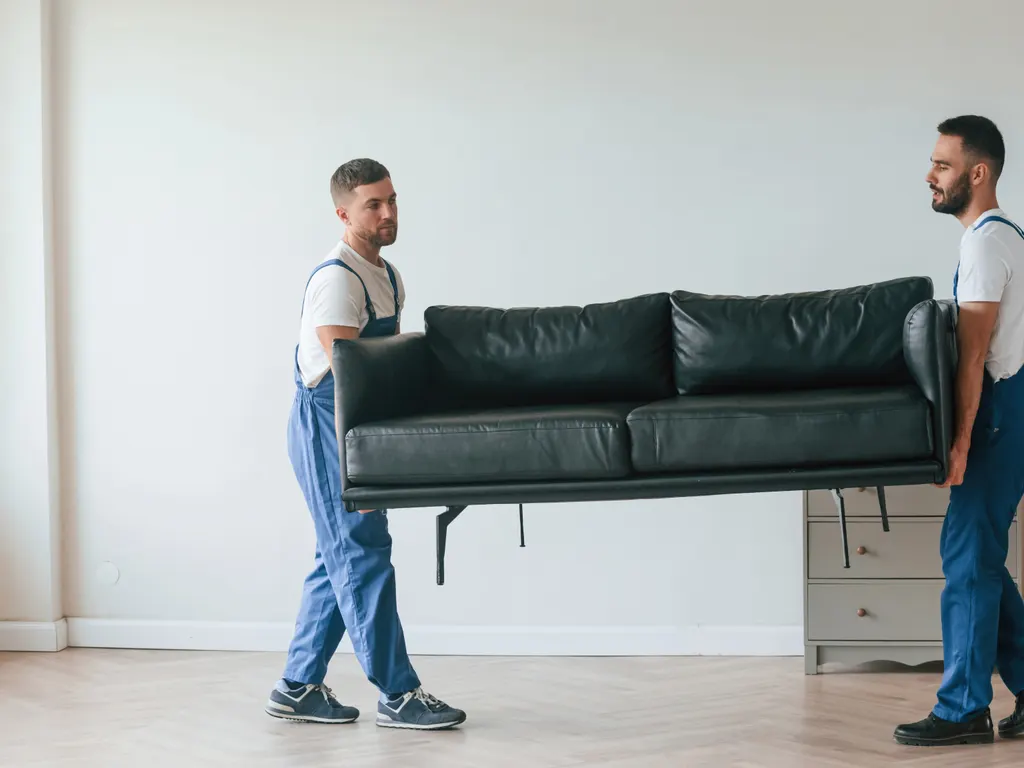
- How many boxes, and how heavy. If the service is front door, the customer needs to know whether two people can carry it upstairs.
- Whether someone has to be home, and how the date gets booked.
What the customer should check on arrival, and how to report damage, is covered in Buying Furniture Online: 5 Pain Points to Answer. It's worth putting on the page before the order, not in the confirmation email after it.
Build the product page around the showroom questions
In a showroom, a customer sits on the sofa, looks at the fabric by the window, and asks how deep the seat is. Online, the product page does all of that. We've written two long pieces on this, so here is the short version and where to go for the rest.
- Dimensions, twice over. The assembled piece (will it fit the room?) and the box and tightest carrying size (will it get through the door, the hallway and the stairs?). Baymard recommends that sites "always provide a 'Dimensions' image that visually links each measurement to its location on the product", because people struggle to match a list of numbers to parts of a piece. The full list of what to measure is in Furniture Dimensions on Product Pages.
- Materials, part by part. "Solid oak legs, oiled; 100% polyester bouclé seat" rather than "wood and fabric".
- Comfort you can put a number on: seat height and depth, and firmness on a stated scale.
- Assembly, stated plainly: needed or not, how long it actually took you, how many people, whether tools are included. If you went flat-pack to get under a parcel limit, this is where the customer finds out what that means for them.
- Samples, if you offer them, linked from the product page. A Baymard participant who spotted free fabric samples said, "I am a touchy person, so I want to feel it."
Photograph for scale, not only for looks
A white-background shot shows the shape. It doesn't show the size. Baymard's product page research found that 42% of users try to gauge a product's scale from its images, while 28% of the large ecommerce sites in its benchmark offered no "in scale" image at all. That's a photo showing the piece next to things whose size everyone knows: a person sitting on it, a doorway behind it, a standard dining chair beside the table.
For a small store this is cheap to fix. One shot per product with a person in it, and one in a real room, do more for the "is it big enough?" question than any number of angles on a seamless backdrop. Try it before you pay for 3D.

Write a return policy you can actually afford
This is where furniture differs most from the products most return policies were written for. The return of a sofa costs roughly what its delivery did, again, plus the chance that it comes back scuffed. So the temptation is to bury the policy, or to copy a generous one and hope nobody uses it. Neither works.
Shoppers look for it early. In Baymard's testing, participants shopping for expensive pieces went looking for the return policy from the product page, and one said, "I wouldn't buy it until I knew for sure that I could return it with no cost." Another said a 90-day window would make them "spend maybe 30% more". Generous terms sell. They also cost money. The honest answer is to decide your terms with the freight bill in front of you, then show them where people are looking.
Four things to settle and write down:
- The window, and when it starts. Delivery date is fairer for made-to-order pieces with long lead times.
- Who pays to bring it back, and whether you collect or the customer has to arrange it. A shopper with no van reads "customer arranges return shipping" as "no returns".
- Restocking fees, if any, in figures. Consumer Reports notes US furniture stores may charge 10 to 20% and may not refund the original delivery fee. Charging one is your call. Surprising someone with it isn't.
- What can't come back: custom upholstery, made-to-order finishes, opened mattresses.
Then put those four within one click of the buy button. Strict terms shown up front lose you some sales. Strict terms discovered after delivery lose you the customer, and usually leave a review about it.
The cheapest return, though, is the one that never happens. Most "it didn't fit" and "it wasn't what I expected" returns trace back to something the page didn't say. Turn the section above over and every item on it is a returns fix.
A launch checklist for each piece
Before a piece goes live, walk it through this list. It takes about ten minutes a product. Dull, yes. It's also most of the gap between a store that just lists furniture and one that survives its own delivery bills.
- Packed size and weight measured, and checked against your carriers' limits and surcharge bands.
- Assigned to the right shipping profile (parcel, freight, local delivery).
- Service level, lead time and box count stated on the product page.
- Dimensions of the piece and the box, with a labelled dimensions image.
- Materials part by part, comfort measurements, assembly details.
- At least one in-scale photo.
- Return terms (window, who pays, fees, exclusions) one click from the buy button.
If you sell furniture on Shopify, we built Mitasu for Home to hold most of that list in one block on the product page: dimension sheets with a doorway-fit check, materials and finish part by part, and assembly and delivery details reused across products. It doesn't pick your carrier or write your return policy, and it isn't meant to. The checklist works with or without it.
Frequently asked questions
What's the hardest part of selling furniture online?
Shipping and returns, because both are priced by the size of the box rather than the value of the piece. Decide how each product ships (parcel, freight or local delivery) before you set its price, and write a return policy with the cost of collecting a returned piece in mind.
Can I ship furniture with regular parcel carriers?
Smaller and flat-packed pieces, often yes. Carriers set hard limits on weight, length and length plus girth, and add surcharges well before those limits; above them, the piece has to go by freight. Measure the packed box, not the product, and check it against your carrier's current rules, which change most years.
What delivery information should a furniture product page show?
The service level (front door, inside, room of choice or assembled), the lead time, how many boxes arrive and how heavy they are, and whether someone must be home. Shoppers use this to compare stores, so it belongs on the product page rather than only at checkout.
Should a furniture store offer free returns?
Only if the margin can carry the cost of collecting the piece. Many stores charge a restocking fee or don't refund the original delivery. Either can be fine; what hurts is the customer discovering it after delivery. Show the window, who pays, any fees and what can't be returned near the buy button.
Sources: Baymard Institute: 3 Key Takeaways For Furniture & Home Decor UX (2024); Baymard Institute: Always Provide a "Dimensions" Image; Baymard Institute: Provide at Least One "In Scale" Image; Unishippers: Oversized vs. large shipments (UPS size limits, 2025); C.H. Robinson: NMFC changes in 2025; Ryder: Ultimate Guide to White Glove Delivery (2026); Shopify Help Center: Shipping profiles; Shopify Help Center: Local delivery; Consumer Reports: How to Make Furniture Delivery and Returns as Hassle-Free as Possible (2020).