
Search for "ecommerce 2026" and you get predictions. This article does not do that. It is already September 2026, which means the predictions can be checked. What follows is built only from primary sources published by government bodies and by the platforms themselves between 2025 and 2026, and from what those sources actually let you conclude. Every number links to where it came from, so check anything that looks wrong.
The short version: the biggest change in ecommerce this year is not that the market grew. It is that an agent has moved in between the shopper and the shop, and what that agent reads is not your site design. It is your product data.

Ecommerce in 2026: what the numbers actually show
Start with the market. The most recent trustworthy public figure comes from the U.S. Census Bureau, published on 18 August 2026: second-quarter 2026 e-commerce sales of $340.2 billion, 17.1 percent of total retail sales, up 12.2 percent year over year. That is well ahead of total retail. You still hear that ecommerce growth has flattened; the measured US number disagrees.
Japan is a different story, and worth saying plainly. Japan's Ministry of Economy, Trade and Industry runs the country's official ecommerce survey, and the newest edition published as of September 2026 is the FY2024 survey, released on 26 August 2025, covering calendar 2024. The next one is not out.
That sounds like a footnote, and it is not. If an article quotes "Japan's 2026 ecommerce market", the figure is almost certainly 2024 actuals or somebody's estimate. An annual statistic running eighteen months behind is a poor instrument for a year in which AI has been rearranging buying habits every few months. So we will leave market size there. Whether the market is growing matters less right now than whether the mechanics of buying have changed.
The front door moved: AI use doubled in a year
Japan's Ministry of Internal Affairs and Communications publishes an annual white paper, and the 2026 edition has a clean number in it. The share of individuals who have used any generative AI service reached 58.8 percent in the FY2025 survey, against 26.7 percent the year before. More than double in twelve months. Text-generation AI alone went from 24.0 to 55.0 percent.
Adoption doubling in a year is not a normal curve. But that measures people who have used AI, not people who have shopped with it. For shopping, the best public measurement comes from Adobe, working from its own analytics.
Analysing more than a trillion visits to US retail sites, Adobe reported in March 2025 that traffic from generative AI sources grew 1,200 percent between July 2024 and February 2025. Small bases make big multiples, so the behaviour underneath is the more interesting part: visitors arriving from AI bounced 23 percent less and viewed 12 percent more pages per visit than visitors from other channels. They were reading.
At that same point they were also 9 percent less likely to convert. Worth keeping in view, though: in July 2024 that gap had been 43 percent, so it was closing fast. Adobe's survey of shoppers who used AI found 55 percent researching, 47 percent getting product recommendations and 43 percent hunting deals.
That is the evidence. Our reading of it: through 2025, AI was where people went to find out, not where they went to buy. Through 2025 is doing real work in that sentence.
What actually changed in 2026: AI can complete the purchase
Turning AI from a research tool into a buying tool is work that happened across 2025 and 2026, and it did not arrive as a scatter of features. It arrived as industry specifications.
OpenAI: the Agentic Commerce Protocol
OpenAI publishes the spec for completing a purchase inside ChatGPT, and the shape of it is almost boringly plain. The merchant supplies structured product data as a CSV or JSON feed. A shopper searches inside ChatGPT, ChatGPT calls the merchant's endpoints, and the merchant validates the order, works out fulfilment, calculates tax, processes the payment and decides whether to accept or decline. The merchant stays the merchant.
Google: the Universal Commerce Protocol
Google announced UCP on 11 January 2026. The documentation describes it as "a new open standard that unifies digital commerce" that "enables direct, instant purchases across AI surfaces like AI Mode in Google Search and the Gemini app". It is open source, interoperable with AP2, A2A and MCP, and is extending into lodging and food. Here too, the retailer remains the merchant of record.
And what retailers have to supply is not something new. The documentation says merchants can "use your existing Merchant Center account shopping feeds to capture high-intent shoppers during discovery". Whatever is in your product feed today is the raw material an AI gets to work with.
Shopify: one set of product data, every AI surface
On the same day, Shopify announced that it had co-developed UCP with Google. Etsy, Wayfair, Target and Walmart worked on the standard, with more than twenty further companies endorsing it, among them Visa, Mastercard, Best Buy and Adyen. Shopify merchants can now reach Google's AI Mode and the Gemini app, Microsoft Copilot and ChatGPT, managed centrally from the Shopify admin. Shopify also opened its Catalog to non-Shopify merchants for the first time.
None of this is a payments story, and none of it is a chatbot story. It is plumbing: set your product data up once, and your products travel into several different AI conversations.
Getting found by an AI turns out to be a data problem, not an ad problem
The specifications spell out, in detail, what an AI needs in order to handle your products. What is on the list is strikingly unglamorous.
Fact: the attributes the specs ask for
OpenAI's product feed spec has nine required fields: item ID, title, description, URL, brand, seller name, image, availability and price. Then the optional list starts, and it reads like a product page: size, material, dimensions, weight, color, condition.
Optional does not mean skippable. OpenAI's own guide states that "recommended attributes—like rich media, reviews, and performance signals—improve ranking, relevance, and user trust". The required fields make a product sellable. The recommended ones are what make it findable.
Google is blunter still. Read the product data specification for apparel and you get this:
sizeis required for clothing and shoes targeted to Japan, the US, the UK, France, Germany and Brazilcoloris required for apparel in those countries, and for any product sold in more than one colourmaterialis required when it distinguishes one variant from anotheritem_group_idis required for variants in those same countriesage_groupis required for apparel there too
On the optional side you can submit up to 100 product_detail entries and between 2 and 100 product_highlight entries. It is all in the specification.
Then, in the 11 January 2026 announcement, Google said it had added "dozens of new data attributes in Merchant Center designed for easy discovery in the conversational commerce era" to Merchant Center. The examples given: answers to product questions, and compatible accessories.
Interpretation: what we take from that
Facts end there. What follows is our reading.
People have been saying product information matters for as long as there have been product pages. The reason was always that shoppers read it. What changed in 2026 is who else is reading. The shopper reads; an AI reads on the shopper's behalf; and that AI decides whether your product appears at all.
The novel part is that the basis for the decision got published. A clothing item with no size attribute does not meet the listing requirements for Google Shopping in Japan. A blank material field keeps you out of any conversation that filters on fabric. And if nothing in your data answers "can I wash this?", the product-question attribute Google just built has nothing to hold.
One caution, because it would be easy to misread this as "optimise for the machines". Look again at the list of attributes: size, material, dimensions, weight, colour, what goes with what, the questions people keep asking. Every one of them is something a shopper wanted to know before buying. These fields did not become important because an AI asked for them. A container that machines can read finally exists for things customers were always asking about. That order matters.
So what do you change on the product page?
Practical part. None of this needs Mitasu, and you can start today.
1.Move information out of the description and into fields
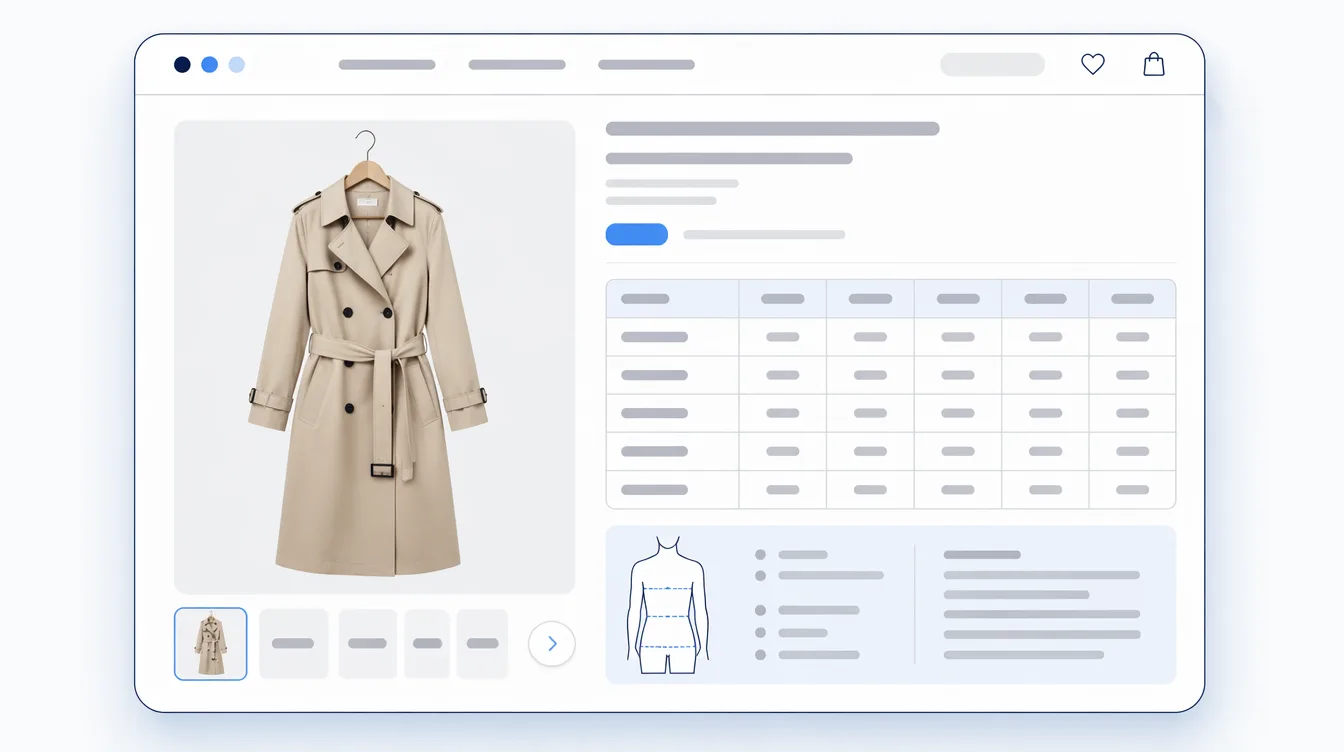
This is the one that pays. “100% cotton, model is 170 cm wearing a medium” in your description is one string to a machine. Material in a material field and size in a size field is what reaches a feed, drives a filter, and gets read by an AI. On Shopify that means metafields; for Google it means the matching Merchant Center attributes.
It looks like busywork. It has a side effect worth having: fields make gaps visible. Nobody notices that thirty descriptions never mention fabric. Thirty empty cells in a material column are impossible to miss.

2.Start with the attributes that are actually required
When there is too much to do, do the ones that are listing requirements. Selling apparel into Japan means size, colour, age group, and an item group ID for variants. Without those four you are not in the free listings at all.
3.Turn the questions you keep getting into data
Google added a product-question attribute because questions arrive mid-conversation. Go back through your support inbox and your reviews: any question that has come in three times is information missing from the page. Writing them per product never finishes, so keep them in a form that several products can share.
4.Finish a few products rather than half-finishing all of them
This one might just be our preference, and a bigger catalogue may argue the other way. But ten flagship products with complete data beats two hundred at sixty percent, for the simple reason that you can tell whether it worked. If it did, you know to carry on. If everything is half-done, you cannot even tell what went wrong.
Closing this gap, one industry at a time, is what we build. Mitasu for Apparel holds size charts, materials, model-worn details and product Q&A as fields rather than description text, and renders them in one lightweight block on the product page. They are templates you assign to products, so thirty products cost about what one does. However you decide to store it, though, the test is the same: can a shopper, and an AI, find the answer before checkout?
What we could not establish
What we failed to verify belongs in here too.
First, there is no official 2025 or 2026 figure for the Japanese ecommerce market. As above, METI's most recent publication covers 2024. If you see "Japan's market grew X percent in 2026", check which survey and which year that number came from.
Second, we could not source a 2026 measurement of how much AI-referred traffic converts. The Adobe figures here were published in March 2025, when AI traffic still converted 9 percent below other channels. There are reports of continued improvement since; we could not reach the original, so we have not used the numbers.
Third, neither UCP nor the Agentic Commerce Protocol has published what it is actually moving in sales. The specs and the participants are verifiable. The results are not in. Which is why you will not read "2026 is the year of AI commerce" here. What can be said is narrower: the plumbing of buying was rebuilt this year, and what runs through it is product data.
Frequently asked questions
Is the ecommerce market growing in 2026?
In the US there is a measured public figure: the Census Bureau puts second-quarter 2026 e-commerce sales at $340.2 billion, up 12.2 percent year over year and 17.1 percent of total retail. For Japan there is no official 2026 number yet, because METI's most recent published survey covers 2024.
What has AI actually changed about ecommerce?
An agent now sits between the shopper and the shop, able to search for products and carry the purchase through. Google published the Universal Commerce Protocol in January 2026 and OpenAI published the Agentic Commerce Protocol before it, making in-conversation purchasing an industry standard rather than one company's feature. Both are built on the merchant supplying a product data feed, and in both the retailer stays the merchant of record.
What do I have to do to get found by an AI?
Sort out your product data. OpenAI's spec requires item ID, title, description, URL, brand, seller name, image, availability and price, and defines size, material and dimensions as further attributes. Google requires size, colour, age group and an item group ID for apparel sold into Japan. There is no special AI integration to buy; it starts with holding product information in fields instead of in the description.
Isn't it enough to write it in the product description?
For a shopper reading the page, yes. To a machine it is a single string. Feeding it, filtering on it or letting an AI read it all need material in a material field and size in a size field. Fields also show you at a glance which products are missing what.
Does a small store need to deal with this?
The work is the same for a small shop as for a large one, and fewer products means you finish the required attributes sooner. Rather than half-filling the whole catalogue, complete your best sellers first, see whether it moves anything, then widen.
Sources: U.S. Census Bureau — Quarterly Retail E-Commerce Sales, 2nd Quarter 2026 (published 18 August 2026); Japan Ministry of Economy, Trade and Industry — E-Commerce Market Survey (latest published edition: FY2024, 26 August 2025); Japan Ministry of Internal Affairs and Communications — White Paper on Information and Communications 2026, individual use of generative AI services (July 2026); OpenAI — Agentic Commerce: Product Feed Spec; OpenAI — Agentic Commerce: Key concepts; Google for Developers — Universal Commerce Protocol (UCP); Google Merchant Center Help — Product data specification; Google — New tech and tools for retailers to succeed in an agentic shopping era (11 January 2026); Shopify — The agentic commerce platform (11 January 2026); Adobe — Adobe Analytics: Traffic to U.S. Retail Websites from Generative AI Sources Jumps 1,200 Percent (17 March 2025). All URLs checked on 12 September 2026.